Showing posts with label chemicals. Show all posts

Tuesday, April 30, 2013

Supergrass, the Couch Potato and the Roundup Gang

Having failed to work on my allotment in a year, I arrived there recently to start again but found it covered in what we (in our extended gardening family) have always called "scutch" - although it's also known variously as couch grass, witch grass, quack grass, dog grass or quitch.

Online there are as many suggested solutions to eradicating the creeping pest as it has nicknames. However all posters are agreed that the weed is hugely difficult to get rid of.
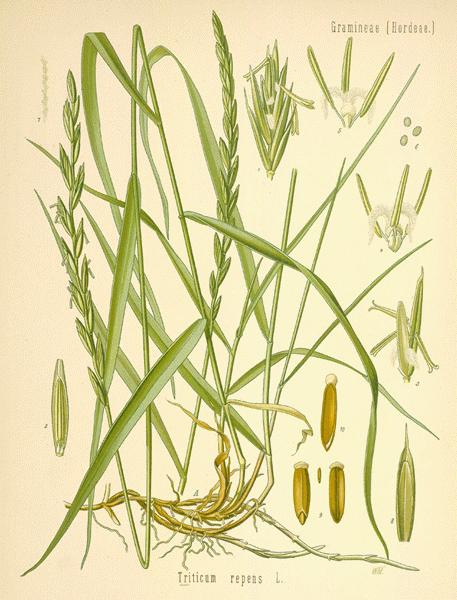
Couch grass, the rampant underground crawler

It gets its most common name - couch grass - from ye olde days when it was commonly used as a stuffing material for couches and easy chairs - presumably because the abjectly indestructible stuff is almost impossible to break down and appears to last forever. Furniture restorers are seldom surprised to find 300 year old furniture pieces still containing visibly rigid straws of couch grass.

You'd understand how this works if you saw the state of my allotment - covered with what can only be described as a thick matting of four to five foot long strands of rhizones. The plant spreads by sending out these underground runners - although these are generally to be found just 10cm below the surface.

Couch Grass - Traditionally used for cushioning the seats of couches
It's extraordinary how much ground it can cover over a few months. Pulling on a handful is like bringing up a spaghetti of electrical cables trained along a wall. Pop, pop, pop, and before you know it, the clump you've grasped has become a long rug of the stuff.

The cream coloured rhizones of scutch/couch grass were also used to make incense in medieval times when other more resinous materials were in short supply. That's another suggested way of getting rid of the stuff - burning it at every opportunity.

The problem with the couch grass plantation is that any process which chops it up will simply cause it to repopulate in greater numbers with every little shred and smidgen capable of regenerating to make another virulent new plant  - just like Mickey Mouse's mop in the iconic "Sorcerer's Apprentice" sequence from Disney's "Fantasia."

More like this actually....A couch oozing antique couch grass yesterday
A good many allotment holders and food growers to have tried to strim the stuff off, or have rotovated couch covered ground only to find themselves mired a few months later in a gardener's nightmare.

The most supported solution is to spray it off with weedkiller - not really an option if you have other food plants intact as a normal allotment would do. But in my case there's little being cultivated at the moment but the fruit trees and the rhubarb. 

My brother - who runs the maintenance division of a leading national landscaping firm is a veritable "doctor death" when it comes to expertise in weed killing poisons and chemicals. He says the only solution is to "go chemical" - something I've never done before on my allotment (apart from early experiments with bluestone and blue slug pellets). But it might be justified this time.

He says the use of a glyphosate based spray like Roundup would not be detrimental to the soil - that the weed killing chemicals won't linger and will dissipate as soon as I hit the ground. This I find hard to believe. However it may be the only answer to the scutch plague.

Roundup -  the extreme option
It certainly beats the option put forward by another allotment holder who suggests digging half a grave sized hole (three foot deep) in the ground, weeding out all your couch grass and burying it alive. Apparently the grass is unable to regenerate at this depth. But this seems like overkill to me (have you ever tried to dig a grave?!!).

So Roundup it is -  at least so I can have some more time on the couch .


Thursday, September 13, 2012

Rumble In My Jungle - The Allelopath Wars


Chemical warfare isn't an invention of mankind. Long before mustard gas, plants were merrily dosing one another with foul concoctions designed to maim and kill. These chemicals are known in science as Allelopaths.

Allelopaths are chemicals used by plants to damage one another and are administered by different methods which include diffusion in the air from leaves, flowers or stems, soakage into the soil via root systems and distribution through fallen leaves.

It seems one of the most effective users of this chemical warfare is the black walnut tree which owners will observe, creates a protective blank space of earth around it in which few other plants can live. Other noted allelopathic killers include hackberry, garlic, eucalyptus and black cherry.


When Garlic Sprouts Attack ...."AAAAGHHH!" 
The effects of destructive allelopaths include hindering growth or preventing it altogether by issuing chemicals which prevent rival seeds from germinating.

But plants don't only seek to eliminate or limit their competitors with chemicals. Some use chemicals to encourage other mutually beneficial species which don't provide a threat - and indeed may help their cause attracting the right insects for pollination and so on.

Food gardeners have known about the effects of allelopaths for thousands of years and employ them constructively in what we commonly call "companion planting" today. For example gardeners know that garlic is destructive against peas, cabbage and beans but helpful in keeping pests away from carrots or tomatoes. Peas and beans, who both pursue the same nutrients in the soil, actively combat one another, as do lettuces and parsley.


"Three sisters" planting in my garden - squashes, beans and corn helping one another.
The central american native peoples used beneficial planting to increase the crop potential of beans, corn and squashes. The "three sisters" method they deployed also produced physical benefits for the crops in question. The beans used the stout corn stalks as beanpoles to climb on to get vital sunlight and with their flowers, helped attract pollinating insects for the corn. 

The hungry ground ranging squashes were fed by the nitrogen gathered and locked into the soil gathered by the beans and in turn would provide a natural ground cover to prevent the soil drying out under the sun while the spines on its stalks and foliage would limit pests. All three plants helped one another. It would be common sense to assume that their chemical allelopaths also aided the process.

But of course, it is the destructive aspects of allelopaths that attracted my interest...

So, in the interests of science you understand....I decided to pitch some allelopathic heavyweights against one another in my garden to see what the outcome would be..

BOUT ONE - TOMATO V FOXGLOVE


Tomato - sweet to eat but the deadly nightshade's relative has foliage brimful of deadly solanine
In the red corner: The tomato plant - Solano lypopersicon. Often attacked by fungi in a damp climate like Ireland's but never by insects. Known natural toxin arsenal includes solanine - known to kill pet dogs. 

In the blue corner: The hardy nasty native - the Foxglove - Digitalis pupurea L. - living in Irish woodlands for tens of thousands of years, spectacular orchid like blooms and big thick heavily wrinkled foliage - almost never nibbled. Toxic. Natural toxic arsenal includes a chemical commonly used in a last ditch attempt to stimulate the human heart  - causing it to spasm - or go into shock. Interestingly however French gardeners have long let Foxglove free seed among their vegetables and salads because they believe it causes stronger growth and builds up disease resistance. This plant operates with a big allelopathic punch.

I stuck a juvenile of each of them in one planter and stood back to watch the show. Surely a bout of floratic chemical wrestling to beat all?


Foxgloves (left) meet tomatoes (right) in a fight to the finish

I had often planted tomatoes in containers already crowded with low ranging plants - and with great success, so I knew tomatoes can live in close proximity with myriad species.  Nearby I planted the same size tomato plants (about a foot high)  in other containers and on their own. There were also other foxgloves alongside in their own containers - both sets of solitary plants would provide a control by which to measure the effects on the two plants of different species which would be forced to share a container. 


The results were astounding.

Within two months the foxglove's growth was impaired by about 25pc compared to the other non container sharing foxgloves. However the one sharing with the tomato was the only foxglove of all of them all to go into bloom - perhaps feeling an urgency to do so. On the other hand, the young tomato plant sharing a root system with the foxglove, lost leaves and did not gain any growth at all. The remaining leaves turned from green to purple. In contrast, the other tomatoes in adjoining containers pursued their normal growth patterns.

Foxglove 1 Tomato 0.
Puree-ed!
In the raised beds I witnessed another non intentional allelopathic war. 

 BOUT TWO - MINER'S LETTUCE V BUTTERCUP

In the red corner - miner's lettuce is a voracious north american ground hugging plant with succulent like leaves. It was named for the great gold rush during which miner's caught in snow bound conditions often survived using it as a food. Over a number of years the plant had spread far and wide in the raised beds and was now out of control. So dense is its growth that it would be difficult to see how any plant could compete with it.


Miner's lettuce starting to spread - you can see the buttercup starting in the right hand middle left of the pic 
In the blue corner - buttercup. I had last year distributed new topsoil around the garden which wasn't as sterile as it could have been. There were buttercup, nettle and dock seeds in it which began to sprout throughout my garden. Next to the miner's lettuce, a ground crawling buttercup surfaced. It's a plant known to be highly toxic. This would be an interesting battle.

It would end up being a knock out. Within just weeks the buttercup was dominant and the miner's lettuce had been completely eradicated.

Buttercup 1 Miner's Lettuce 0.

Now the buttercup has moved over to impinge on the territory of a very vibrant and pungent crop of sage. I'm already selling tickets.


In the same spot weeks later... the miner is shafted and the buttercup squares up to the great sage..
Science is still in the early stages of studying allelopaths which may in the end provide us with beneficial eco weedkillers as we harvest and use some of these plant chemical weapons against weeds. 

Five to four on buttercup anyone?