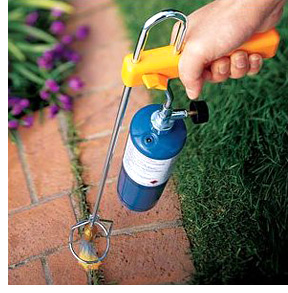
I thought I’d heard him right. “You want to buy a what?” I did hear him right!!
What do you do dear reader if your pension age dad - master of showing up with cuts, grazes and fingers like an elastoplast mummy - announces that he’s going to buy a flame thrower? This is the man who once set the chimney ablaze by cutting off bits of his Christmas tree and feeding it into the livingroom fire - seceteured electric fairy light segments and all. Only my dad could set his chimney alight thus threatening an all out housefire while simultaneously risking electrocution.
We got onto the subject of flamethrowers by way of a discussion about chainsaws - of which he has two (this one's electric, that one's petrol) despite living in a terrace house with a rather small garden and little about to chainsaw. He likes his dangerous gadgets does my dad. Woe betide anyone who breaks into his house. Especially now that he’s in the market for a flamethrower. They must be selling them at Lidl.
-“What the hell do you want a flamethrower for?!“
-“To burn off weeds.”
“-You’re not having a flame thrower!”
-“Ha ha! Yes I am.”
 |
| Would you let this man have a flame thrower? |
A weed burner would be a more correct description. However a weed burner is indeed a faithful reproduction in miniature of the very same notorious device once deployed by marines to toast stubborn hole hugging Hirohito-ites in the Pacific.
But the trouble with a retired man of a certain age having a flame thrower at hand is that he’s likely to start trying it out for uses other than that which is proscribed. Perhaps he’ll have a go at a wasps nest with it, or go after mice. He also needs to know that while a weed burner is a more eco friendly way of going after weeds on footpaths and walking areas than toxic chemicals, they should not be used on growing soil because they also kill the organisms which help it do its thing.
 |
| Flamethrowers - not suited for garden work |
For much of the year, weeding is one of the home food grower’s main duties. Inevitably they grow faster than your crops especially if the crops happen to be carrots. Carrot growers in particular will find that because of the need for a finer tilled soil, their neat lines of seedlings soon disappear amongst a amongst a forest which appears to include every specimen in the book. I spent an hour picking my way through one carrot bed last year, removing the tallest weeds first, chickweed last, before finally determining that there weren’t actually any carrots left in there at all.
 |
| A weed burner as bought on Amazon - not the same thing |
By way of making weeding easier and by way of giving the amateur grower a grounding in identification of what others fondly term “wild flowers,” every year in July, at the peak of the weed season, the Organic Centre in Rosniver, County Leitrim offers a course a course in weed identification and study given by leading horticulturalist Ingrid Foley. To give us a taster of what my dad might be applying his flamethrower to, I’ve asked her to give the low down on fsome of the most stubborn specimens out there.
 |
| Really Digging the weeds - that's Ingrid on the right (Sligo IT) |
“While we might hate weeds, they absolutely love us,” says Foley. Experts believe that some weeds have actually evolved ways of getting humans to help in their regeneration. “Weeds employ a number of devious and clever devices to harness people and animals in order to reproduce.”
And this is what you need a flamethrower for because bittercress sets its very own IEDs. Brush past a ripe bittercress and it literally explodes, hurtling hundreds of tiny seeds all over your plot. Other ingenious weeds include the ubiquitous Cleavers, otherwise known as Galium Aparine, or more popularly here in Ireland as the “stickyback.” This hitches a lift on humans or animals in order to spread its seeds. The plant is covered in microscopic hooks which fasten to our clothes, break loose and “hitch” until the hooks slacken and the seeds/segments drop off elsewhere. Other plants like the Red Dead Nettle trick insects into carrying their seeds away.
“Then there’s the airborne invaders like dandelion and thistles which generate seedheads made up of hundreds of tiny parachutes enabling them to glide off to new ground.” Finally let's not forget the sneaky “creepers” in the long grass which send out “runners” that can span across a vegetable bed within a few short weeks.
So in the interests of providing humanity with the necessary intelligence to claw back some growing ground from the dastardly ones - here's Ingrid's field combat guide to warfare with the garden baddies:
Chickweed
Thus called because we feed it to chickens. We can also feed it to ourselves because it’s edible for humans and contains a remarkably high amount of nutrients and minerals including potassium, riboflavins, magnesium, beta carotene and it’s especially high in iron. Unfortunately that’s because it’s depleting all this good stuff directly from your soil.
Light green in colour, it spreads at ground level in dense mats and contains a little white flower which five white petals. You can identify it as chickweed if the five are divided by little black lines to give the appearance of ten petals. Chickweed goes to “sleep” at night when it folds it bigger leaves over the emerging tender shoots to protect them from colder tempeatures.
It tends to develop in a great big tangle, it breaks off easily and is therefore tremendously difficult to uproot. Not only will it spread like lightning but it’s also “ephemeral” which means it’s one of those annuals which can go through its reproductive cycle a number of times in the season. “Chickweed can produce 2,500 seeds per plant and move from seed to maturity within two months or so. So you can see why its necessary to keep them down.”
 |
| Chickweed yesterday |
The best method unfortunately is to just keep pulling out those chickweed nests. Some people put them in the juicer to tap those minerals for themselves. But don‘t try to eat your way out of a chickweed infestation - it was once used to relieve constipation so you‘ll spend more time you know where than weeding. Chickweed is one of those weeds which can be used in compost (before it seeds) to get those minerals back into your soil again.
 |
| Scutch grass in the early 19th Century (no cameras then) |
Scutch Grass/Couch Grass
Deployed on golf courses and once used to stuff mattresses and upholstery (hence the couch bit), scutch is the long distance runner of the weed world. It establishes itself not only by seed but by laying its stalk out along the ground and setting out little rootballs from each little “elbow” along the shoot. In this way, a single stalk of skutch can establish four plants along a one foot line in less than a week. Unfortunately there’s no easy way of getting it out other than rake out every little bit you find. Watch when you’re strimming, even apparently yellow and dry segments can suddenly reroot and form a scutch plantation. Absolutely do not use a rotivator if you have a scutch problem and Ingrid Foley says, do not let it within a hare’s breath of your compost heap or bin.
 |
| There's no Dock holiday at my allotment |
Dock
Docks are the bane of my life on Plot 34, where a dock spikes up in almost every fresh bed I dig. These sprout from the hundreds of seeds which the parent plant produces on its “spike” heads. Dock seeds tend to pop up on certain types of ground - usually freshly cleared ground like on a relatively new allotment complex.
The seedlings are not very competitive and are easily snuffed out in grasslands by competing plants. Unfortunately they have a secret weapon - extended suspended animation. They can go to “sleep” and bide their time in the soil for more than 50 years until some eager food growing newbie clears the carpet above and stirs the whole lot from suspended animation.
Once the plant establishes its “tap root” it’s almost impossible to remove and those who have broken the eco code by spraying or injecting them with high powered poisons will note that the dock will waver but will always recover. “I don’t think I’ve ever got the bottom of a dock tap root,” says Ingrid. “This is unfortunate because like a dandelion, they can grow back again. The common types in Ireland are the regular flat leaf (rumex obtusifolius L.) and curly dock (numex crispus). “All you can do is keep cutting off that shoot head again and again to try and deplete the tap root. However someone told me on one of their courses that they dug out a tap root and nailed it to a door where it dried out completely. The thing somehow managed to sprout again.” And they’re everywhere… until that is, you get a nettle sting.
 |
| Suspended animation - some weeds can do this even without 1950's scientists |
The hairy bittercress
The rather harmless looking hairy bittercress, a common garden weed, has an explosive secret. The bittercress is a booby trap primed by mother nature to be detonated by unsuspecting vegetable growers - just one of many clever and diverse aids to reproduction that weeds deploy in our gardens.
Touching or brushing off ripe bittercress causes the seed pods to literally explode and scatters its payload of 300 seeds per pod to a distance of a metre in all directions.
As an “ephemeral” it’s also fast maturing and can produce seven generations in one growing season. Multiply this by 300 per flower/pod on each plant and you’ll quickly realise why this edible baddie is so hard to eradicate from your plot. The flat rosette shape of the plant even gives it the appearance that it has already “exploded.”
 |
| Hairy explosions from the bittercress |
It looks like a green rosette or star spread out flat on the ground. It’s stems have individual rounded and succulent-like leaves which reduce in size as they move out towards the tips. The flowers which form at the end of stalks have four white petals. The trick is to get them in spring before detonation. You can eat the younger plants in salads just like watercress.
Shepherd’s Purse
Named after its heart shaped seed pods which are covered in a gummy oil which enables them to stick to clothes and fur. Another ephemeral which can reproduce many times in a season, it has a spray of long narrow jagged harpoon shaped leaves from a central stem and it sends up long flower stalks with four petalled white flowers on all sides. It was used in WW1’s trenches as a styptic to stem blood flow from wounds and also has astringent qualities to shore up diahorrhea.
 |
| Some sticky shepherd's purse yesterday |
“With Shepherd’s Purse and Cleavers you can actively bring weeds into your own garden by walking around someone else’s,” says Foley. “This is particularly prone to happen in an allotment complex where people are in and out of their neighbours plots.” Pull it out before it flowers.
Red Dead Nettle
Easy to identify because of its small purple orchid like flowers which poke out randomly from around little upright columns of spade shaped green leaves. These are thick and wrinkled with a purplish tinge to the top. A single isolated plant can produce 27,634 seeds and it has two other secret weapons. The first is the ability of its seeds to go into suspended animation or dormancy.
 |
| Purple hazard - the red dead nettle - not red at all! |
This can last five years and in some cases, there have been instances recorded of 30 year old seeds germinating. The second secret weapon is the plant’s symbiotic relationship with the ants. The seeds are coated in a residue which ants feed to their larvae. So ants carry the seeds into their nests and when the seeds have been sucked dry they’re taken to the nest’s “rubbish area” which is rich in nutrients from dead ants and discarded matter.
The Dandelion
Every part of the dandelion is edible although young leaves taste best. Their medicinal use in times past as diuretics to aid liver and kidney complaints has led to the myth among children that contact with them causes you to wet the bed. They come with harpoon shaped leaves, and the distinctive yellow heads are actually a multitude of tiny flowers bunched together. Each turns into a little “parachute” with a feather like canopy which travels on the wind causing a massive spread of seeds which will sprout from a crack in a wall.
 |
| (yes I know...) |
It’s not enough that 93 species of insect are drawn to them for nectar and pollinate them, the Taraxacum also has the ability to “clone” itself by reproducing asexually just in case. In loose soil, a slow steady pull can sometimes get the entire root up. Otherwise use a “rooter” tool, a sort of metal stick with a sharpened and slightly elevated groove at the end. Chopping the root into parts can cause each part to regrow as a brand new plant.
Creeping Buttercup
With maple shaped green leaves, the creeping buttercup has a huge armoury of assault weaponry including the rapid spread by runner for which is it famous - a sly creeping motion whereby it creates new plants along its spreading arms. It has mass coverage and Rumple Stiltskin level dormancy in its arsenal (80 year old seeds have been recorded to germinate while 12,000 seeds have been recorded in one metre square), animal travel (it’s eaten and excreted by worms, birds and rodents), indestructibility (it survives deep burial and heavy trampling). But most sneaky of all it deploys its own chemical warfare on rival plants- which include your crops.
This dastardly creeper releases substances (allelopaths) which slow their growth. So despite the girly monicker which might suggest butter wouldn’t melt in its mouth, this delicate cup is overflowing with poison. It is a true herbicidal maniac!