Tuesday, April 30, 2013

Their Gojis Are Bigger Than Yours


 “Mine’s bigger than yours” - You get it in all hobbies, pastimes, pursuits and in war mainly.You don’t mind competition, you just don’t like the mouthies who insist on telling you that they’re better at food growing - that their gojis are bigger than yours.

Their gojis are the size of your marrow fat peas, their peas are the size of your cherries, their cherries the size of your sprouts, their sprouts the size of your onions and their onions the size of your head (which by now has a pain in it).

Thankfully, unlike say, World Federation Wresting and rap, you don’t get too much of the old bragging in the gentle world of food growing.  There’s green eyed jealousy among the green fingered in droves, but rarely do people openly boast about the size of their nuts.
Except within family.

It was THIS big!!!
But family doesn’t have those normal feelings-sensitive receptors which we normally deploy when we dealing with the rest of society at large. At the same time, we tend not to mind an assault of horticultural superlatives as much if they happen to come from a family member. Like a turnip, your skin is thick skin to familial cuts.

As it happens my extended family has the most gardeners ever (boasting here) - and everyone is an expert. We also like to tell each other as much. 

My brother is a graduate of the country’s leading Botanical College and now head of the biggest division within the country’s biggest landscaping outfit – so he at least has a fair claim to superior green fingers. I'm the one with the column, the book and blog (boasting again).

Two of my uncles and my dad get their gardening cojones from the university of gardening life and it is from this quarter that I get the majority of the “size” based vegetable spoutings.  My dad, known as  EOE (expert on everything) likes to dig up anything that isn't performing in his garden and make a present of it to me (the daft thing is he tells me this as he’s handing them over) and then he brings me in to his garden to show off the food producing that are excelling: "Loganberries, the size of your THUMB - have you ever seen the like of them?!"

One uncle we meet for a beer every week has been known to slap a big (not huge) onion on the counter in the bar at 10.30pm and chirrup “Well what do you think of THAT then?! Now THAT’S an onion. THAT’S what I call an onion.”

My uncle taking one of his onions to the bar yesterday
With my youngest uncle recently joining my Dad in retirement, the competition heated up at his end. And he’s got himself a greenhouse. “You’d want to see the SIZE of the cucumbers …and the tomatoes MASSIVE tomatoes” – his hands spread out, his eyes bulging for effect as he tell it.

When the previous uncle couldn’t make it to our weekly drinks session, he couldn't resist giving my Dad an outsized lettuce head he’d grown to take to the bar - just  to show me how big they were growing them up at his place. Except Dad didn’t bring it  – he chopped it up instead and ate it. “Mmm yea it was biggish alright,” he conceded slightly when accosted over it a week later. ..........“Not as big as mine tho.”

Supergrass, the Couch Potato and the Roundup Gang

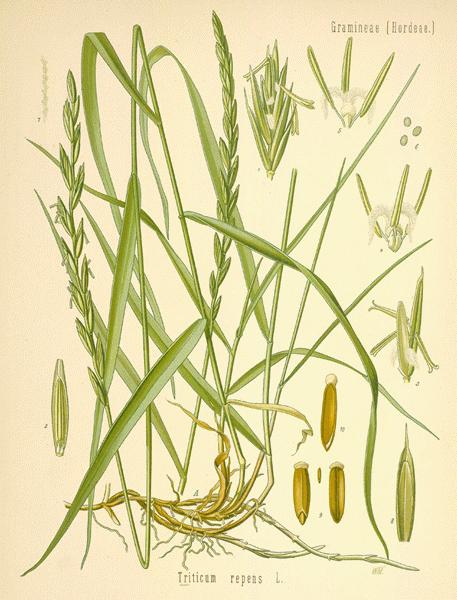
Having failed to work on my allotment in a year, I arrived there recently to start again but found it covered in what we (in our extended gardening family) have always called "scutch" - although it's also known variously as couch grass, witch grass, quack grass, dog grass or quitch.

Online there are as many suggested solutions to eradicating the creeping pest as it has nicknames. However all posters are agreed that the weed is hugely difficult to get rid of.
Couch grass, the rampant underground crawler

It gets its most common name - couch grass - from ye olde days when it was commonly used as a stuffing material for couches and easy chairs - presumably because the abjectly indestructible stuff is almost impossible to break down and appears to last forever. Furniture restorers are seldom surprised to find 300 year old furniture pieces still containing visibly rigid straws of couch grass.

You'd understand how this works if you saw the state of my allotment - covered with what can only be described as a thick matting of four to five foot long strands of rhizones. The plant spreads by sending out these underground runners - although these are generally to be found just 10cm below the surface.

Couch Grass - Traditionally used for cushioning the seats of couches
It's extraordinary how much ground it can cover over a few months. Pulling on a handful is like bringing up a spaghetti of electrical cables trained along a wall. Pop, pop, pop, and before you know it, the clump you've grasped has become a long rug of the stuff.

The cream coloured rhizones of scutch/couch grass were also used to make incense in medieval times when other more resinous materials were in short supply. That's another suggested way of getting rid of the stuff - burning it at every opportunity.

The problem with the couch grass plantation is that any process which chops it up will simply cause it to repopulate in greater numbers with every little shred and smidgen capable of regenerating to make another virulent new plant  - just like Mickey Mouse's mop in the iconic "Sorcerer's Apprentice" sequence from Disney's "Fantasia."

More like this actually....A couch oozing antique couch grass yesterday
A good many allotment holders and food growers to have tried to strim the stuff off, or have rotovated couch covered ground only to find themselves mired a few months later in a gardener's nightmare.

The most supported solution is to spray it off with weedkiller - not really an option if you have other food plants intact as a normal allotment would do. But in my case there's little being cultivated at the moment but the fruit trees and the rhubarb. 

My brother - who runs the maintenance division of a leading national landscaping firm is a veritable "doctor death" when it comes to expertise in weed killing poisons and chemicals. He says the only solution is to "go chemical" - something I've never done before on my allotment (apart from early experiments with bluestone and blue slug pellets). But it might be justified this time.

He says the use of a glyphosate based spray like Roundup would not be detrimental to the soil - that the weed killing chemicals won't linger and will dissipate as soon as I hit the ground. This I find hard to believe. However it may be the only answer to the scutch plague.

Roundup -  the extreme option
It certainly beats the option put forward by another allotment holder who suggests digging half a grave sized hole (three foot deep) in the ground, weeding out all your couch grass and burying it alive. Apparently the grass is unable to regenerate at this depth. But this seems like overkill to me (have you ever tried to dig a grave?!!).

So Roundup it is -  at least so I can have some more time on the couch .


Monday, April 22, 2013

A Spud Scheme For An Unsprung Spring


A recent life change has seen me building a new business as a media consultant. It's meant a lot of ten and twelve hour days over the last twelve months - mostly for very little return. But the business is moving out of its establishment phase and into growth mode.

Unlike my allotment.

The career change has meant that, for the first time in a decade, I haven't been gardening for almost a year - at least not on my allotment. This is just as well, as I've mentioned in recent posts, the soil was getting a bit tired.

And my old muckers up at the allotment complex -  my "comrades in farms" - tell me I happened to pick the very best year in living memory to stay away. The yields last year were abysmal thanks to unpredictable weather patterns, which have continued right into this year.

Here in Ireland we haven't had a proper spring so far this year. The first properly warm sunny days have only arrived in late April. Through all of my years with an allotment, it's been common to have a warm sunny period of four weeks or so around Easter which follows some weeks of growth before that - usually from around St Patrick's Day - March 17. It means the plants are usually well underway by now. But even the strawberries in my back garden are only just showing new leaves at the moment.


Alaskan March in Ireland this year ....whose is the fat and pale kid with the dodgy teeth?
Having visited my allotment yesterday (April 21) for the first time in a year, it was quite a surprise. The place looked and felt more like late February or early March. The ground was wet, cold and mucky and apart from a lush cluster of rhubarb, there was very little growth in evidence. To add to the problem, it's on high ground and therefore is normally a few weeks behind anyhow.

We've just had the coldest March on record. Weather experts say that the melting arctic ice caps are changing the behavior of the Jet Stream which separates cold arctic weather streams from warmer westerly weather for Ireland. This year the line did not shift until much later, leaving us with the colder conditions for longer. We're told this will be more frequent going forward.

There was an item on the news last night about Irish farmers importing hay from the UK because they didn't have enough silage left to feed their cattle. I don't remember this happening before in a country where we have to get up once a year to clear grass out of our gutters. If it weren't for a few clusters of grape hyacinths in the garden and the longer days, we wouldn't think winter had finished at all.
Cold, mucky and damp, no growth....spring is unsprung
And of course, it's at times like these that the council creates bother with its "special rules" for their leased allotments. Since the beginning we haven't been permitted to have sheds of any sort for tool storage and shelter in the rain. So I got soaked yesterday. One guy tried to get around this by installing a children's plastic "wendy" house, but they made him take it away. The trouble is that they keep adding to their list of "special rules." Their latest one is  - no more ground sheets permitted. This strikes me as being pretty ridiculous given that the use of sheeting or cardboard is an environmentally friendly way of keeping the weeds down and also for keeping the soil a little bit warmer to give us that little head start.

Many years over I've returned to my allotment in March and simply rolled back the ground sheets to find friable and ready to use soil which didn't require any digging. Now I'll have to dig the whole lot over every year.

Another council rule is that every allotment must be more than two thirds dug over by the end of April. Yesterday my soil was mucky and sticking to the fork in big clodden, tacky lumps. It's in no way friable and digging it in its current condition will probably damage it. But if I want to avoid a clatter of a clipboard, I'd better get underway at pace.

The other problem I have is that the whole place is covered in a thick carpet of scutch grass - great big six-foot long fronds of the stuff. This is known elsewhere as Couch Grass or Bermuda Grass and expands by throwing out long runners across the ground. On the good news front, the fruit bushes are looking to be in good shape, there was a big pile of rhubarb to harvest and a lone surviving cauliflower that was absolutely delicious for dinner that night.


Grape Hyacinths provide the only signals that winter is gone
So I have a plan. 

I'm going to cover most of the allotment ground with potatoes this year. First off, this amounts to some good old fashioned financial sense. Last year was so bad for potato farmers that the price of spuds has more than doubled here in twelve months. Potatoes produce more food per square metre (even in a bad year) than any other crop I can think of. So planting up with spuds will save me a decent chunk of change as well as providing plenty of food for the table.

The second reason for planting potatoes is that my ground has settled and become compacted after more than a year without digging. Potatoes have an effect of breaking up the ground and making it friable again. This is one of the reasons seasoned allotmenteers will often plant virgin ground up entirely with potatoes. It breaks the soil up for easier use the following year.

Then there's practicality. With less time on my hands I won't be able to afford constant weeding attention for peas and brassicas and onions. Once spuds get established, they pretty much smother out most other weeds. With the soil still cold and mucky, spuds offer a reasonably hardy solution to the makings of another bad year for growers.


Sprouty spuds to cover lost ground
Finally, when the potato plants wither back, the spuds stay cosily in the ground waiting for you to come along and harvest them when it's convenient.

Stupidly I paid E5 each for three bags of seed potatoes. I should have remembered my previous success with bags of plain old supermarket potatoes which went sprouty. I'd have gotten four or five times more seed spuds for my money. The pink red supermarket Roosters did especially well for us in 2011

Leaving spuds in a bright spot in your kitchen gets the shoots growing - what's called "chitting." I tend to cut them up into chunks with an "eye" root sprouting from each one. This means that each sprouty potato gives you four or five new potato plants. I plant them about a foot apart and then leave them alone to do their thing.

So that's what's what for the price of potatoes.


Friday, March 29, 2013

Those Early Spring Murders


THROUGH our still dark spring evenings, murders have become more prominent in our city. Suburbanites on their way home from work in the sunset evenings can hear those unnerving cries from the remoter wooded areas of the city's public parks.

On these dark evenings you can hear the cries of  murders....
Early sunset is the signal for huge collective swirls of crows (known as murders) to circle noisily before roosting for the night.


Back in the early winter months they would fill up at farmer’s grain fields and at allotment complexes like ours. Back home in the garden where I had a score of cabbages under bird netting and within reach of our cat, the tell tale signs are still there that crows have still managed to have a go at them and strip hefty lumps from the close guarded heads.

Now that spring has sprung they'll soon be driving allotment owners crazy by picking out pea sprouts to feast on them. I recall the year before last when one grower on our allotment complex lost a huge pea bed and showed me a single lone pea shoot remaining. He swore that the crows had left it there “just to torment me.” Science is showing that crows do indeed play jokes – on each other at least.

Corvids have been a long time pet subject for the US  technologist and author Joshua Klein who has devoted more than ten years studying the behaviour of crows and has also presented a much lauded TED talk entitled "The Amazing Intelligence of Crows."
Josh the crow man - see his thought provoking TED presentation  at http://www.ted.com/talks/joshua_klein_on_the_intelligence_of_crows.html
Science has only recently realised that corvids, the bird family which includes crows, ravens, jackdaws, magpies and jays, are at least of equal intelligence to apes and dolphins. In experiments crows in particular have been observed bending lengths of wire into hooked tools. They have also been observed using three different tools in sequence to solve a problem, the only animals on earth to do this without training - apart from humans. This means using a short tool to hook a medium length tool that is out of reach, using this in turn to hook a longer tool similarly out of reach and finally, using this to hook food which can only be reached by the longest tool.

In Japan they have been observed dropping nuts among traffic at pedestrian crossings. The cars crack the nuts and the crows wait until the lights have stopped the traffic before strutting out to eat them safely, returning to the curb when the sequence starts to change again. More recently I was told by a fisherman friend how he and his fellow anglers were forced one day to row their boats in double quick time when crows started picking out fresh water oysters exposed by a drought and dropping them on the roofs of the fisherman’s cars from a height to crack them open.
Crows - swotting up on the habits of humans.
Crows have long had a reputation that causes food growers to persecute them as vermin. Gun clubs up and down the country reward their members with bounties payable on the heads of grey crows and magpies. Points are awarded which are later redeemable against cartridges.  And despite experts claiming that crows rarely attack lambs but rather prey on the corpses of those who die young, it is still accepted that they are killers. Hanging crow carcasses upside down is common practice on farms holding sheep as well as food crops.

For his part though Klein decided it’s time to stop persecuting such intelligent animals and to think of ways for your local murder to do something constructive. So he hired them.

Klein invented a crow “vending” machine which dispensed one peanut every time a coin was dropped into it. He conditioned his local crows by covering the machine in coins and when a crow inadvertently knocked a coin down the chute,  a peanut was dispensed. Soon the crows were busy shoving coins down the chute to get peanuts. Before long the coins on the machine had been used up, but Klein had placed more coins around it. While the placed coins around the machine were soon used up,  the crows realised that once they had found a coin, they could take it back to the vending machine, insert it in the slot and earn a peanut.
Josh Klein's Crow vending machine - earning him cash in the recession .
Klein has yet to tell us how much he has earned by hiring crows rather than persecute them but he stresses that his crow vending machine was designed to prove his point that it was indeed possible to train a wild an intelligent species like crows to do constructive things in exchange for reward.  He has proposed ideas to thus condition crows to pick up rubbish after stadium events or to pick out expensive components from discarded electronics. He’s even suggested search and rescue functions.

While crows have long been considered the food grower’s nemesis and a general pest, we food growers sometimes lose sight of the fact that they also serve vital functions in the environment and help us in many ways.

First they are garbage removers by eating carcasses of deceased animals, second they are ceaseless predators of other pests that eat our crops notably  mice, slugs, snails, caterpillars, grubs and moths. Maybe we should give them a break. 

At least some leniency might finally stop them wrecking our cars and otherwise playing tricks on idiot humans!

Thursday, September 13, 2012

Rumble In My Jungle - The Allelopath Wars


Chemical warfare isn't an invention of mankind. Long before mustard gas, plants were merrily dosing one another with foul concoctions designed to maim and kill. These chemicals are known in science as Allelopaths.

Allelopaths are chemicals used by plants to damage one another and are administered by different methods which include diffusion in the air from leaves, flowers or stems, soakage into the soil via root systems and distribution through fallen leaves.

It seems one of the most effective users of this chemical warfare is the black walnut tree which owners will observe, creates a protective blank space of earth around it in which few other plants can live. Other noted allelopathic killers include hackberry, garlic, eucalyptus and black cherry.


When Garlic Sprouts Attack ...."AAAAGHHH!" 
The effects of destructive allelopaths include hindering growth or preventing it altogether by issuing chemicals which prevent rival seeds from germinating.

But plants don't only seek to eliminate or limit their competitors with chemicals. Some use chemicals to encourage other mutually beneficial species which don't provide a threat - and indeed may help their cause attracting the right insects for pollination and so on.

Food gardeners have known about the effects of allelopaths for thousands of years and employ them constructively in what we commonly call "companion planting" today. For example gardeners know that garlic is destructive against peas, cabbage and beans but helpful in keeping pests away from carrots or tomatoes. Peas and beans, who both pursue the same nutrients in the soil, actively combat one another, as do lettuces and parsley.


"Three sisters" planting in my garden - squashes, beans and corn helping one another.
The central american native peoples used beneficial planting to increase the crop potential of beans, corn and squashes. The "three sisters" method they deployed also produced physical benefits for the crops in question. The beans used the stout corn stalks as beanpoles to climb on to get vital sunlight and with their flowers, helped attract pollinating insects for the corn. 

The hungry ground ranging squashes were fed by the nitrogen gathered and locked into the soil gathered by the beans and in turn would provide a natural ground cover to prevent the soil drying out under the sun while the spines on its stalks and foliage would limit pests. All three plants helped one another. It would be common sense to assume that their chemical allelopaths also aided the process.

But of course, it is the destructive aspects of allelopaths that attracted my interest...

So, in the interests of science you understand....I decided to pitch some allelopathic heavyweights against one another in my garden to see what the outcome would be..

BOUT ONE - TOMATO V FOXGLOVE


Tomato - sweet to eat but the deadly nightshade's relative has foliage brimful of deadly solanine
In the red corner: The tomato plant - Solano lypopersicon. Often attacked by fungi in a damp climate like Ireland's but never by insects. Known natural toxin arsenal includes solanine - known to kill pet dogs. 

In the blue corner: The hardy nasty native - the Foxglove - Digitalis pupurea L. - living in Irish woodlands for tens of thousands of years, spectacular orchid like blooms and big thick heavily wrinkled foliage - almost never nibbled. Toxic. Natural toxic arsenal includes a chemical commonly used in a last ditch attempt to stimulate the human heart  - causing it to spasm - or go into shock. Interestingly however French gardeners have long let Foxglove free seed among their vegetables and salads because they believe it causes stronger growth and builds up disease resistance. This plant operates with a big allelopathic punch.

I stuck a juvenile of each of them in one planter and stood back to watch the show. Surely a bout of floratic chemical wrestling to beat all?


Foxgloves (left) meet tomatoes (right) in a fight to the finish

I had often planted tomatoes in containers already crowded with low ranging plants - and with great success, so I knew tomatoes can live in close proximity with myriad species.  Nearby I planted the same size tomato plants (about a foot high)  in other containers and on their own. There were also other foxgloves alongside in their own containers - both sets of solitary plants would provide a control by which to measure the effects on the two plants of different species which would be forced to share a container. 


The results were astounding.

Within two months the foxglove's growth was impaired by about 25pc compared to the other non container sharing foxgloves. However the one sharing with the tomato was the only foxglove of all of them all to go into bloom - perhaps feeling an urgency to do so. On the other hand, the young tomato plant sharing a root system with the foxglove, lost leaves and did not gain any growth at all. The remaining leaves turned from green to purple. In contrast, the other tomatoes in adjoining containers pursued their normal growth patterns.

Foxglove 1 Tomato 0.
Puree-ed!
In the raised beds I witnessed another non intentional allelopathic war. 

 BOUT TWO - MINER'S LETTUCE V BUTTERCUP

In the red corner - miner's lettuce is a voracious north american ground hugging plant with succulent like leaves. It was named for the great gold rush during which miner's caught in snow bound conditions often survived using it as a food. Over a number of years the plant had spread far and wide in the raised beds and was now out of control. So dense is its growth that it would be difficult to see how any plant could compete with it.


Miner's lettuce starting to spread - you can see the buttercup starting in the right hand middle left of the pic 
In the blue corner - buttercup. I had last year distributed new topsoil around the garden which wasn't as sterile as it could have been. There were buttercup, nettle and dock seeds in it which began to sprout throughout my garden. Next to the miner's lettuce, a ground crawling buttercup surfaced. It's a plant known to be highly toxic. This would be an interesting battle.

It would end up being a knock out. Within just weeks the buttercup was dominant and the miner's lettuce had been completely eradicated.

Buttercup 1 Miner's Lettuce 0.

Now the buttercup has moved over to impinge on the territory of a very vibrant and pungent crop of sage. I'm already selling tickets.


In the same spot weeks later... the miner is shafted and the buttercup squares up to the great sage..
Science is still in the early stages of studying allelopaths which may in the end provide us with beneficial eco weedkillers as we harvest and use some of these plant chemical weapons against weeds. 

Five to four on buttercup anyone?


Sunday, August 19, 2012

Kids These Days...

The back-sliding french glass door of the house is opened to air the kitchen in the morning and my two youngest children -  my four year old daughter and her toddling brother (nearly two) are off down the garden like a shot - in search of forage. Casting wily eyes to the house to ensure they're not being watched and to confirm we don't know what they're up to, they work fast.

They know exactly where to go. They try to appear as casual as a four and two year old can on a raid.

The nearly-two-year-old keeps his eyes fixed on the kitchen window for his mother's or my attention as he rapidly plucks blueberries off the bushes and shoves them into his mouth. From the same plants he also picks half-purple half green berries and small and hard all-green berries. Into his mouth they go indiscriminately. He chews and swallows fast - he might be caught at any second.

By this time his sister is at the raised strawberry bed, eyes similarly fixed to house windows as her delicate hands frisk the strawberry foliage on autopilot and come back with handfuls of big strawberries filled with big holes harbouring tiny slugs and many different mite sized insects -  and brown furry mould fuzz.

Into her mouth they all go.

Then our internal alarm clocks go off. We suddenly wonder "Why so quiet?" and "What are they up to?" and "Are they with you? No? Are they with you?" We look out the kitchen window. "Crap!"

We run down the garden path and hook our pinky fingers into their mouths to get the green berries and slugs out. "Spit it out... into Daddy's hand." 

Come on, you know the drill.

The next morning the two are sitting at the breakfast table.

I sprinkle washed and cleaned and wholesome blueberries and handfuls of cleaned and fur free strawberries over their breakfast cereal. The bowls are placed in front of them alongside their orange juice.

Our four year old daughter wrinkles her nose and prods her spoon reluctantly into the bowl. Her nearly-two-year-old brother is already picking out the berries and flinging them randomly over his shoulder onto the tiled kitchen floor. Our daughter puts on her whingiest and whiniest voice. 

- "But I don't like berries Daddy!"

Is Nature trying to tell us something?


Sunday, August 12, 2012

Sharing With the Pests

When I was a kid I once threw a huge flip because the homegrown pear I was eating had a dead wasp in it. A big huge bite uncovered the expired intruder deep in his fruity tomb.


My grandad, who had grown up in the countryside, was far less squeamish about insects and bugs. He reprimanded me for being such a sissy (as gnarly grandfathers are wont to do) and took out his trusty pen knife to shuck away the damaged part of the pear - handing the rest of it back to me to finish eating it - which I did, albeit in somewhat more cautious bites.

He had a point. Over the years our attitude to pest damaged food has become quite ridiculous. In the west we simply throw anything away that has a nibble - be it holey greens or part fouled fruit. 

Inspecting the strawberries for pest damage.
However recent scientific research has shown that nibbled and holey greens contain additional chemicals which have been generated by the plant itself in order to fend off pest attacks. It turns out that these chemicals contain anti oxidants which are of particular benefit to humans when we eat these "holey" foods. So pre- nibbled food might actually far better for you.


Nibbled plants also produce chemicals to attract predatory insects - greens being mauled by caterpillars will eventually exude a substance which attracts wasps, which in turn eat the caterpillars.


This year we've had to share our strawberries with the slugs in a big way. It's been a bumper year for slugs in Ireland. I've never seen so many, in such large sizes and in so many different varieties. I think there's good evidence to suggest that this time they may have overpopulated.

"Ow, ow, owww!" Desperate slugs sliding over dry gravel yesterday.
They seem particularly desperate for food. I've watched them nibbling at greens they've never bothered with before, notably the leaves of foxgloves. I've also seen them moving in dry conditions, perhaps in an attempt to get ahead of the posse in the hunt for food. I've seen them eating one another, as I mentioned in a previous recent post. I'm seeing them travel over surfaces they normally avoid - over dry gravel and across the bristles of horse hair mats.  I've even seen them moving along the washing line suspended high in the air.


The slug plague hasn't boded well for my strawberries which have just faded out of season. This year they fruited extremely well, but the slugs have put big holes in at least half of the fruits. My one-and-a-half year old son loves his strawberries and regularly makes his way to the strawberry patch to raid it. So slug pellets are out.

Our other big strawberry pest is on the mooch...
With about half of the fruit ending up holey and a quarter of them about 50pc eaten, the temptation is to throw the damaged fruit into the compost bin. But that's just too much wastage for me to countenance.

In our household at least, they get washed and the holed parts are cut away so all surfaces have been cleared of areas which have had contact with the pests. Usually I end up with a clean half or a quarter fruit each time, which is better than nothing. It means I can save about a quarter of the crop by weight overall that would ordinarily get thrown away. 

I also leave some of the larger holed behind fruit on the plants to give the slugs an easy target and to act as a decoy from the soon-to-ripen fruits.

Last year it was vine weevils, this year it is slugs, next year it will no doubt be the birds or something else. There's always something. And while we'll always do our best to minimise the damage, we also have to accept that pest spoil is a fact of life with home grown food. So let's not defeat our own efforts by consigning every pre-nibbled example to the compost.
Nibbled and mauled but still usable

In contrast, today I picked some berries from a completely untouched strawberry plant located elsewhere in my garden. There were four or five juicy fruits, albeit small ones, which had not been molested by the slugs at all. 

So what's the difference between this plant and my other strawberries? 

The latter is in fact a "wild" strawberry variety of the sort that has been growing free in Irish and European temperate woodlands for thousands of years. The slug hammered varieties (see the picture above) - are all from the most commonly grown commercial varieties in Europe (like Elsanta) which happen to have their relatively recent origins in the USA and South America. These have only arrived here in the last few hundred years.

 What it does illustrate is that mother nature has provided the local varieties with all the necessary defenses against the slimy predators. Which of course begs the question: Why do we bother at all growing "higher yielding" imported varieties that can't defend themselves - especially if we either end up losing most them to pests or else spending huge amounts on pest control? Perhaps wild strawberries demonstrate that the answer to proper pest control might just have been on our doorstep all along.


Wild boys! Too much for gravel hardened slugs to handle..


Friday, July 27, 2012

Ireland's "Green" Growing Skinned by Teagasc

Shame on Teagasc the Irish Agriculture and Food Development Authority which has just announced its intention to begin trials of genetically modified potato crops shortly at it's site in Oak Park in County Carlow. 

Here the agency is expecting to commence years of trials for blight resistant GM spuds on a two hectare site and in the process, giving the GM monster it's first proper foothold in Ireland.

Despite widespread use in other countries, including the USA where corn crops are being hammered at the moment by drought, there have been no proven benefits with GM crops. They have not reduced pesticide use and they have not created loaves and fishes style feeding miracles in third world countries. 

"Down boy!" A Teagasc genius is patted on the head by Ireland's first GM spud birth."We call him Ruprecht" the official announced yesterday.

They have however been proven to crossbreed with other non-GM varieties and it's a fair assumption that the long term effects of GM foods are not yet known. 

We are told the go ahead for the experiment was only agreed after close consultancy with the Environmental Protection Agency (what do they know about GM?) and the Food Safety Authority!!! (Do you want sauce with that?!) 

What about asking consumers across Europe who are firmly against GM tainted foods? What about proven non GM blight resistant potato strains which produce plenty of good yields but are too irregular sized for the modern big corporate processing machines to handle? The truth is it's not just about blight control but also the corporate costs of making processing cheaper.

Teagasc says blight costs E15m each year and that they need to save a few bob for the poor farmers. Australia thought it would save a few bob by bringing in rabbits to keep the grass down. But what does losing Ireland's global GM free reputation cost?  Answers on a postcard to the Oak Park numpties.


Wednesday, July 4, 2012

Slug Explosions - Why Other Slugs Eat Them

The other day I stepped on a slug on the patio. The slimer did exactly what any one of us might do if something  638,888.889 times heavier than us had accidentally stepped on us - it exploded.
Sadly - the fact of having the great and accessible powers of Dr Interweb at your fingertips in the modern age means you can't just be curious about one of those obscure and ridiculous fleeting thoughts that comes into your head (in this case: "Oh, I wonder how many times heavier I am than a slug?") and then move on sensibly (as nature intended). 

No siree - seeing that I had the great online collective world brain right at my fingertips to go poking into -  I just had to go and find out.

I came back to this blog half an hour later feeling simultaneously proud and embarrassed that I had actually taken the trouble to work it out. But seeing I did it, you were dang well going to get the right number - six hundred and thirty eight thousand, eight hundred and eighty eight point eight eight nine times heavier. I am six hundred and thirty eight thousand, eight hundred and eighty eight point eight nine times heavier than an average garden slug.
Dr Interweb's Mighty Brain yesterday
But I took the long way around.

When I keyed in my question "How much does a slug weigh?" I soon discovered I wasn't alone. There were lots of people like me on the web asking this very question.

Unfortunately no one online ever seems to taken the trouble to coax an invertebrate up on a scales - understandable perhaps given that you don't really want them sliming about on your kitchen weighing system. You could perhaps try guessing it's weight, but guessing a beast's weight is all a bit too small town country fair for me. Oddly, plenty of people have weighed garden snails.

The question did produce an equation from Wiki answers. There's even a formula to show what one slug equals and another to show how one slug fits into 1lb f whatever that is.


1\,\text{slug} =1\,\frac{\text{lb}_F\cdot\text{s}^2}{\text{ft}}
\qquad\Longleftrightarrow\qquad
1\,\text{lb}_F = 1\,\frac{\text{slug}\cdot\text{ft}}{\text{s}^2}

Unfortunately, as well as being a land crawling invertebrate, a quick drink from someone's hip flask, and a spent lead bullet, a slug just had to be a measurement of mass, thus making my search considerably more discerning.

Finally I uncovered a clue - that the average crawler can eat 60mg in one go - about 40pc of its equivalent body weight.

From this I worked out its actual weight, converted mine into mgs and then divided one into the other to come up with the answer (Yes I should get out more often - but I have kids - what's your excuse?).

What relevance does this have to the story?

None. But this is my blog. 

Back to where I was.

It exploded. But when I came back that way later I discovered three slugs of various sizes chowing down on the splatted carcass. Not only that, there were many more slugs from five or six feet (miles to them) away, with the foot to floor in a bid to get there before all the dead slug debris was gone.

Having lived in a wet green country all my life and gardened for most of it, I'd never seen such a phenomenon - cannibal slugs!!

A slug having a friend around for dinner
Since then I've seen the same thing happen a couple of times - perhaps because I was watching out for it.

So I looked it up again on the internet. This time the results came quicker. And yes indeed, slugs do like to tuck into one another - though in almost all cases on already dead slugs.

It's just a pity the birds don't seem to be eating them this year because the garden is overrun with them. I planted marigolds to keep pests down and the slugs ate them! There are squillions of the little gets and I've gone nuclear with the nasty blue pellets which I absolutely hate to reach for, but without them there'd be nothing standing in the garden. I've even seen the slugs chowing down on the leaves of my Foxgloves, which I don't remember them ever doing before. I planted marigolds just to help keep the pests away - but the slugs ate them too.

There were more Marigolds in this picture earlier....

Yes I know, beer traps. Great if you can afford to give yours to the gastropods and you still have to empty the beer/slug muck afterwards. No thanks. And those white pellets which are supposed to be environmentally friendly and child safe - they just dissolve at the first drop of rain.

I've a better idea again, based on what I've learned.

So now another one of those thoughts has come into my head. It's a new slug trap which I think I'll patent. Essentially it's a big hob nailed boot attached to a mechanised arm and a timer which drops the boot to the ground and raises it again every half hour.

It works like this: Stick one squashed slug under your boot, set the timer and leave. Along comes three more slugs to tuck in. On the half hour the boot falls, clobbers the three and raises again, thus attracting more slugs and so on it goes until your garden is clear.

At least that's how it works in theory......

Now see if you can work out how much I weigh. The first correct answer in comments wins the prototype - after I've made my millions.


Thursday, June 21, 2012

Normal Service To Be Resumed Shortly

One aspect of running an allotment or a food garden of any sort is that now and then you're going to have to give it up for a time. Since Spring I've done nothing with my allotment and very little in the garden.


At the start of the year I left my job of twelve years - which readjusted my schedule significantly. Having set out on my own, I've been working round the clock pretty to build up work, start a new project or two and make some cash - to quote George W, so I can "put food on my family." It's going well so far, but the allotment has missed me as a result.


So no spare hours for food growing this year. The Council have even sent a threatening letter to take my allotment off me because I've done so little work up there. And that's their right if it's looking too scraggly. Also the weather has been pretty awful - enough to head me off at the pass on those days I have had free and allocated to Plot 34.


Normal Service to Be Resumed 


I've scattered a load of well matured manure around up there and have let the grass grow because the soil definitely needs a rest. I've been hammering that ground for six years now, hauling great big crops of potatoes, carrots et all from it and the ground needs to get itself back on balance. Despite manuring, the colour has been fading from the soil and it's become a little ashen.


When you're growing a lot of root crops over a number of years, no amount of rotation, manuring and so forth is going to help get that balance back.


I don't believe that fertilizers and manure alone provide true grounds for organic recovery. I've learned enough about soil these last few years to know that it needs to rebuild its stock of micro organisms. 


No ground can be exposed to the elements year in year out without becoming damaged. The natural state of soil isn't to be exposed to the elements - in fact, what we call "weed coverage" is its true natural state. Now the weeds are helping to cover it up and shelter the tiny insects and microbes who will come back into it to do their thing.


Unlike a farmer I don't have spare fields to "rest" them for a year or two. So given my recent recession era schedule, it's as good a time as any to rest that ground.


It doesn't mean I haven't been growing. In the garden the strawberries are starting to ripen up and I've a fine batch of cabbage and broccoli underway. The onions are doing well and up at Plot 34 you still can't stop the fruit bushes doing their thing. My radishes bolted - probably because I put them in the greenhouse - thinking I could "hot house" them along. Good to know I still get some things wrong and that there's still more to learn.


Friday, March 23, 2012

Why Stella The Grumpy Granny Needs You

This is Stella, Ireland's self styled "grumpy granny" from the website www.gm-moratorium.com. Here she is yesterday wheeling her young grandson off to sell him at the farmer's market because he wouldn't behave himself.


OK yes, I'm joking. 


Stella isn't that grumpy at all - except when it comes to the matter of GM foods. Right now she's in the process of making an official complaint against the Pat Kenny radio show for a recent item on plans to introduce GM foods to Ireland. Stella grumps that the programme has misinformed the public on a number of key issues relating to how it explained the GM food process -  and regarding its treatment of news of new plans for Ireland which seemed to have popped up out of the blue.
Stella Coffey is a very grumpy Irish granny
I'm no goose stepping greenshirt by any stretch but I find the recent news genuinely frightening - that Teagasc (the Irish semi state agri research body) is now planning to facilitate GM potato trials in Carlow and that the deadline for public objections to the EPA is only a couple of weeks away. 


And I'm not the first one to be taken aback at just how such a vital issue for Ireland's future has managed to lurk below the media radar until almost the very last moment.


But thanks to grannies like Stella Coffey - who miss absolutely nothing (you know the kind!)  -  the word is now being spread rapidly and the troops are being rallied to resist the GM monster's latest threats. But we have to act fast. On Stella's own website www.gm-moratorium.com she has a petition against this new initiative which I'd urge you to sign post haste. It calls for a five year moratorium on GM plans for Ireland. Stella already has collected 1,600 signatories. You'll see my signature on there, right after that of Darina Allen.


Also make sure you check out her presentation on the current Teagasc GM issue on Youtube:


http://www.youtube.com/watch?v=czl0fR4xieo 


See youtube - and join the grandmother of all GM wars...
This is what Stella has to say: 


"Last Tuesday Teagasc announced that it has an application with the EPA (Environmental Protection Agency) for a licence to grow GM potatoes at Oakpark, one of its research stations that is located in rural Carlow. You have until March 27 before 5pm to lodge a "representative" aka an objection. Remember, if Teagasc gets its way on this, the genie will be out of the bottle because there's no way of recalling these spuds when problems become evident down the line. It took 20 years for the subtle effects of DDT to become obvious - that's just one way Natures bites back."


"My grandchildren have made me realise, all over again, that we need to be wiser about how we use and abuse our world. GM food and crops scare the grandmother in me." And grumpy Irish grans do always have a way of scaring the rest of us into action so Stella might just get somewhere with her one gran campaign.
So why is it that the older generation are the only ones that seem to give a fig about our environment these days - while that once ultra politically active segment - the young adults do nowt but wander about pressing "OMG!" repeatedly into their smartphones? 
The last time we had a proper GM ruck over here was in the 1990's when gnarly campaigners turned up in Carlow to stomp GM sugar beet - leading the charge was the great self sufficiency guru himself, the late great John Seymour (who inspired the 1970's hit series "The Good Life"). Seymour, then a Wexford based smallholder, managed to get himself lifted by the rozzers for beet stomping - at almost 90 years of age! Another multi national tried again in 2007 and ended up securing approval from the EPA for GM tests, but the conditions were so stringent that they didn't bother in the end.
The late great "grump" John Seymour - pinched thanks to his bobby on the beet
Now Ireland's "GM Virginity" is in jeopardy once again. But why the fuss? What the hi de hay does it matter if we inject hippopotamus DNA into sweetcorn - if the end result is great big giant cobs of corn that thrive in wet conditions but don't attack fishermen?
Well if we can actually genetically modify and tweak our food plants in a completely safe manner to increase food quality and quantity then GM food would indeed be a truly great thing. But the big GM question is this: Can we really trust profit-driven multinationals (they're driving GM development) to tinker around with the genetics of food plants on a huge scale - when thus far we can only be certain that: (a) we don't yet understand the ultimate consequences and (b) we know that GM plants can freely interbreed with non GM plants? 

Such is the worry about GM foods that they are banned from many parts of the world. 

Genetic modification is the introduction of alien genes not naturally found in a species (animal genes can be introduced to plants or vice versa) with the intention of producing a desirable quality in that species. And though GM foods are not with us long enough (the first tomato became available in 1994) to truly evaluate whether they are dangerous, the fact that they can and do cross freely with other non GM crops suggests that if they do turn out to be harmful, we have, as Stella suggests, already let the genie out of the bottle.

OMG!! KEWL!! The kids don't care
There have already been allegations that early problems are starting to show. It is alleged that soy allergies have soared by 50% in Britain since GM soy products entered that market. There have been reports that shepherds in India have lost a quarter of sheep that grazed on GM cotton plants when none died after eating non-GM versions.

So let's ask ourselves some other questions: What has GM achieved thus far?  Have the GM food crops - so widespread now in third world countries - ended starvation in those countries as so many GM proponents have promised? Nope. Have they greatly increased corporate profits? Certainly they have. Have they increased the risk of a world ecological disaster on an unprecedented scale? That's the $64,000 question that we still don't know the answer to. 

In Ireland's case we're being told that a GM blight resistant potato would be our reward. But they're not telling us that we already have blight resistant potatoes - grown all over the world and here in Ireland which are not GM crops. The common spud variety "Sarpo" is just one of them. What they're not telling us is that these more organic blight resistant spuds aren't uniform enough in shape and size to fit into the processing machine that big corporations prefer to use to sort, wash and pack their spuds. So it's GM for the corporations not the farmer or the consumer.
Frogrange anybody?
Finally, and still on the commercial front, one thing Ireland does have left in these dark economic times is its green agri credentials. We are still the "green isle," our food grows in the best of soils and, generally speaking, by world standards, it grows in a healthy environment. That's why foreign buyers still place a premium on our produce.

In the long run we might be risking our children's and grandchildren's futures but in the short tem we'll also be throwing away our long valued quality agri reputation away with the loosing of the GM monster. There are enough anti GM people out there throughout our trading partner nations to seriously effect that reputation and damage our food exports.


If you live in Ireland, don't just place a formal objection to the EPA, phone your local politican. Email your objections to the Minister for the Environment, Phil Hogan at minister@environ.ie. If you live outside of Ireland and wish to contribute to the global fight against GM food, write to your Irish embassy to voice your objections.

Finally, I was also joking about Stella's selling the young fella - though Teagasc just might be selling all Ireland's children down the swanny if we let them get away with loosing GM here. I'm with the grumpy grans on this one.