Showing posts with label composting. Show all posts

Wednesday, October 12, 2011

Digesting Some Facts About Dalek Composters

Our Dalek can eat for Ireland. We put kitchen guck in and within a few weeks it has reduced to a fraction of its mass.  The domed scoffer has been shoved to the far end of our garden on account of his occasional propensity to embarassing odours but in fairness to his designers (Davros?), he only ever hums in exceptionally hot weather - or when he’s got a bad case of indigestion.

We feed him with all the food waste that a family with three children can produce in any given week. We keep a big picnic sized portable cooler box in the kitchen and into it goes all our fresh food kitchen waste along with eggshells, egg boxes, loo roll tubes and odd papers. At the end of the week when it’s full and weighs about five kilos, we walk to the end of the garden and sling the rotting guck into the Dalek where the worms, bugs and microbes get to work on it.

For those who aren't from Ireland or the UK, it's time to explain something. A Dalek is either (a) a warlike metal coated alien from the planet something-or-other - as featured in the popular BBC cult science fiction series Dr Who or (b) A popular nickname in gardening circles for a particular type of pepper pot shaped composter which so happens to resemble the sci fi baddie. Indeed with the with the addition of a couple of police lights on top, a sink plunger and an egg whisk to the composter, you'd have some trouble distinguishing kitchen waste digester from menacing and shrill intergalactic nemesis.


A BBC science fiction Dalek yesterday
 Our Dalek is also a big lover of newspapers. Until recently, each and every week he was a particularly big fan of the Sunday Times Culture section which he scrupulously digested each and every week. Unfortunately, they recently changed the paper from a matt to a gloss and now it gives our Dalek a bellyache. Unknown to many, news print is actually a perfect addition to a composter and is a key method of keeping the chemical balance ideal for digestion. It contains plenty of carbon which helps to neutralise the acidity of the "green" waste that comes from our kitchen.


They digest newspapers.... and biographies.....
The "Dalek" style of composter is a giant pepper pot with a removable lid on top, an open bottom which goes on the ground. Some people like to line this with chicken wire to prevent rodents burrowing in. There's also a flat sliding panel on the front bottom which allows access to the black gold that is the mature compost. The open underside allows the earthworms and other insects access which aids the digestion and breakdown process. 


Over the years, I would imagine that its innards by now contain a whole universe of assorted heebie jeebies. But this is only after a degree of trial an error. In the beginning it proved tricky in to get the balance of contents right and sometimes its innards turned to sludge and remained as unusable sludge for much of the year. So anyone who wants to get the most from a Dalek or any other composter will need a period of trial and error to get that balance right.

We must have got that right in the end because the Dalek now exterminates food waste at a remarkable rate and in so doing, saves us a packet of cash in the process. While others pay eight euros every couple of weeks to have their kitchen food waste taken away in a stinky brown bin - our Dalek vaporises the lot in jig time.


GERMINATE!! GERMINATE!! A garden Dalek invasion pic lifted from Mark's Veg Plot (check it out)

The problem is that it’s rather too good at digesting food waste. A weekly installation of five kilo of food guck and the Sunday papers disappears to the degree that the infernal thing is always half empty (not half full), a condition that persists until right until the end of the year. Where does it all go?

Until last year we were also throwing cooked meat products into the Dalek, something you’re not supposed to do because you’ll attract rats. To keep the rats away I judged that our cat Oscar (he’s wild), the biggest cat in western Europe - would scare them off whilst a double under wiring would also keep the rodents out. But this thinking both underestimated the tenacity of rats and overestimated that of fat cats. For a time we ended up with whole family of rodents in the Dalek, something I didn’t tell Her Outdoors about, because  don’t appreciate this type of thing you understand.

Newsprint is good for compost to keep up the carbon levels and balance the "greens"

Indeed many intrusive objects found in its digestive system can be attributed to Her Outdoors “autopilot” school of kitchen cleaning. Uncompostables like foil dishwasher tablet wrappers and yoghurt carton tops cause our annual compost haul to twinkle and sparkle a good deal more than anyone else’s.

It seems the trick to running a happy Dalek is (a) take the trouble to turn the contents on occasion with a gardening fork (b) in dry weather take the time to pour a watering can or two of water into it, to keep it moist and clammy in there.

You'll be richly rewarded by year's end with pure plant food once you manage to get that balance right between the two main types of waste - green waste which is high in nitrogen and includes all kinds of fresh food waste, leaves and grass cuttings, and brown waste which is high in carbons and in our case, is usually made up of degradable paper (including newsprint) and woody cuttings.

If you sling a huge big bag of grass cuttings (green waste) into your Dalek then you’re going to give him indigestion. Large amounts of grass tend to compact and the lack of oxygen inside the slab of grass prevents its break down. So you end up with a big pillow of slime in there.


Exterminated! What happens when you overload your Dalek with grass guck

There are different views on whether weeds with seed heads should be thrown into compost. I keep dandelions and docks out but the rest go in on the grounds that the heat the compost generates will kill the seeds of other plants. Other staples among the kitchen waste are coffee grounds and tea bags.

Adapting a composting regime that sticks can be a tricky process. Essentially its about routine and having a container/caddy in the kitchen which won’t stink the place out. Our picnic box cooler is ideal because the lid seals tight and the waste stays cool inside it until the end of the week. But if we leave the lid off for even a few minutes, next time we lift it, a flurry of nasty little fruit flies will spray out of it. Women in particular have an ingrained reluctance of having anything at all “dirty” in the kitchen. So if you can’t have a sealable container in the kitchen, stick it just outside the back door where dinner plates can easily be scraped into it.

They do like coffee and tea however

Finally, sometime in spring, I slide off the panel on the end and dig out the priceless black gold which should have the colour and consistency of coffee grounds. This is the best food you could ever give your plants. Unfortunately there’s only enough to apply a light dressing on the raised beds in the garden and never enough left over to take up to the allotments. It’s also vital in the greenhouse where it helps our seeds to sprout. Spring is when our Dalek makes most impact and its keyword is: Germinate! Germinate!

Sunday, November 21, 2010

Why My Dalek Won’t Go With the Flow

Each and every day “Her Outdoors” exercises masterful patience with those aspects of our lives which marry the muck of an allotment to the domestic indoors of a tight quartered semi. She has kept schtum about the pest ridden onions on the kitchen table, the rows of mould filled glasses for sloughing tomato seeds on the window sill, the free range slug and earwig passengers we intercept on the cream living room carpet.
But now and then she puts her clog down.
The idea I’d been turning in my head was the ultimate in recycling, borne out of my frustration with the Dalek – what we call our pepper pot shaped garden composting bin.
The Dalek gets fed at least once a week with our food waste, old newspapers, tea bags, peelings, gone off guck, our eggshells and whatnots which all go into a large caddy in the kitchen – a big two foot high picnic icebox job with a sealing handle. Along with this, the Dalek eats the year’s grass cuttings, the weeds, the prunings from the annual garden clean up, the exhausted soil from all the patio containers and at this time, the bags of leaves I collect on our estate. All in all, it works out at about the equivalent of twenty large wheelie bin loads per year.
Despite this, the damned Dalek refuses to fill up. Last week, just before I tipped in the usual caddy of guck, I noted that the proceeds of the previous week’s loads were nowhere to be seen. At all. The Dalek and its resident heebie jeebies had exterminated the lot into a fine dark frithy tith in seven days. Is this possible?


Our "dalek" - exterminating kitchen waste yesterday

Now while this all might seem like good news to you lot, I for one want some compost back in exchange for our guck. But no matter how much I pile in there, I only ever get half a Dalek of compost at year’s end. More tardis than Dalek if you ask me and certainly not enough production to stave off paying retail barn prices for organic compost which is now pound for pound more expensive than a sack of potatoes at Lidl.


Our kitchen guck caddy - the dalek eats two of these a week

I figured that if I couldn’t make more compost, I could perhaps find ways to make it richer and thus, go further. In this regard, I kept returning to something I’d read online a few years ago.
A search on “compost making” had taken me to Julian Cope’s web site of all places. Among the worshipful gushes of aging Teardroppers, an eco warrior chappie named Merrick, who also happens to be one of JT’s good buddies (Temple has mentioned him several times in interviews), offered some good composting advice. Somewhere he adds: “feel free to have a wazz in the heap (compost) if your neighbours aren’t looking.” He notes that human urine is a rich source of nitrogen and an “essential for kick starting compost.”
First, there are dangers associated with “wazzing” in our Dalek – you’d have to climb onto it first and its lid sits about chest height. Second, the neighbours would definitely see you because any viable Dalek wazzer would have to be stood higher than the shed roofs along our garden fence line. However, collecting said “wazz” in a vessel for later transfer sounded like a possibility.


Kevin,  our intrepid gnome demonstating the hazards of "wazzing" in a dalek

I decided to research further because after all, life on earth is based on eating and excreting - a relay exchange of the very same minerals and nutrients from one life form to another and back again. Animals feed plants, plants feed animals.
 "Liquid Gold" by Carol Steinfeld highlights the wonders of human pee for plants not least the high nitrogen and phosphorous levels – two chemicals which are the staples of shop bought and oil based fertiliser. Anna Eday, author of the book "Solviva," claims to have grown 200 onions on a single square yard of ground using only her own pee as fertiliser. Using this and other methods, Eday claims to have grown US$500,000 of food from a single acre.
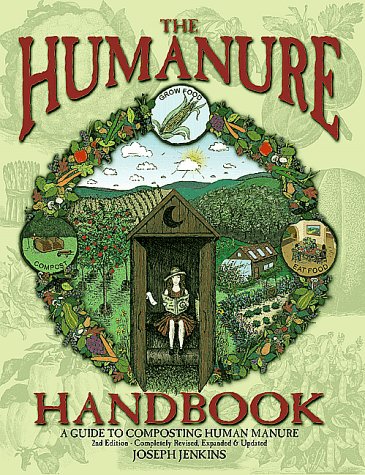
Now take it to the second stage – to number two if you like.  "Humanure" is a best selling book by Joe Jenkins which has gone through two editions and seven different prints since first published in 1995. It’s success has haunted Jenkins who, despite penning many works on myriad subjects, has since become a stalwart of every “and finally..” tv news segment slot that exists in the USA and one more for the BBC.

Joe Jenkin's book the "Humanure Handbook" also available free to download on his website otherwise known as "Humanure Headquarters" - http://humanurehandbook.com/
Jenkins highlights our acceptance of cattle and chicken manure as fertiliser when these contain so much more dangerous pathogens than human waste. And he puts his money where his mouth is – he’s fed his crops on his own family’s waste for more than 20 years without mishap.
Jenkins says the flush toilet, one of the perceived hallmarks of a civilised society, does nothing but transport a valuable food growing resource to the one place on where it can do the most possible harm - into the salt and fresh water eco systems.
Jenkins’ system is a mobile home type “dry” toilet which comes accompanied by a sack of earth, sawdust or (poetically) shredded junkmail. Then the results go into the centre of a great big compost heap with household and other waste on the outside. He points out that the heat generated in a typical compost heap (71 degrees centigrade) is more than enough to kill any pathogens and turn human waste into prime grade manure.
Those who have tried his methods enthuse online that his system is clean and odourless. Mails to his website include one from a relief worker based in a third world country, who, in the absence of a “proper” sewerage systems, has not only managed to prevent disease by halting the use of rivers or latrines (the contents of which inevitably find their way into rivers anyway), but claims to have helped increase local food production considerably in an area where locals can’t afford fertilisers and where animals don’t provide enough.
It’s not a new idea either. The late writer and environmentalist, John Seymour, the grandfather of modern self sufficiency and who inspired the tv series “The Good Life,” always maintained a “thunder box” at his smallholding farm in Wexford where he turned decades of human waste into quality fertiliser. Indeed some of the fertiliser you buy at the garden centre may already have been produced this way, Ringsend in Dublin is among those municipal sewerage plants which already turns human solids into commercial fertiliser.

John Seymour - the grandaddy of the modern self sufficiency movement
But while a “thunder box” is probably more suited to those with a few acres under them, the reuse of wazz in our own semi detached homestead was certainly something which could be considered as an idea to turbo charge our compost. Perhaps a lidded tub placed to one side in the downstairs loo – it could accompany the caddy to the Dalek each week?
So I’d even gotten as far as relating to “Her Outdoors” the idea of hanging up a sign in there, like one of those jokey “if you tinkle when you sprinkle” things but instead asking our guests to “tinkle for our vegetables.”
She, hitherto sitting in incredulous silence, suddenly  shot her arm out, flat hand forward, in the universal sign of “Halt Right There Mister!
And years of carpet running slugs, thiosulphinating onions and crowded kitchen windowsills all spilled out at once. It started with: “We are ABSOLUTELY NOT etc etc etc and did not end for a long, long time.”
It does make absolutely perfect environmental sense in every way. Just not in our household.
And it was at least worth the look on her face  ; )

something like this....