You know you're old when the title years of your favourite childhood sci fi features have already come to pass. Here in 2011, mine are long past. The comic 2000ad (Judge Dredd) and the Gerry Anderson tv series Space 1999 were my particular childhood staples while Kubrick's 2001 also made a big impression on the then mini me.
Back in the late seventies I lived in the assured belief that even the most dynamic starship crew were hamstrung without their all knowing talking computer. This electronic oracle was then characterised either by panel of lights that flashed to the tones of its soothing and patrician electronic vox, or (if the production budget were low on that tv series) a mysterious monotone voice which emanated from some vague space overhead - the crew addressed it by looking vaguely overhead as they voiced their queries.
But whatever the mode, the talking computer had the right answer or solution to save the crew and ship from each and every crisis. Orac from Blake's Seven or Holly from Red Dwarf kept them on the straight and narrow while Hal from 2001 showed what happened if you ticked them off with too many stupid questions.
 |
| The crew from Space 1999 listens intently to the computer's fashion instructions (flares did return about 1999) |
What's this got to do with food growing? I hear you ask as you look vaguely overhead. Well the point is that much of our childhood sci fi has already come to pass even without us realising. Skype is the visual phone call. Robots are already everywhere - and while they can't serve you breakfast in bed they can mow your lawn - robot lawnmowers are already making their debut (see below).
While you might have to key in your queries via keyboard rather than spout them out to to him while peering above into a vague space overhead, the great Dr Interweb clearly is the obvious manifestation of sci-fi's talking computer - with Captain Youtube as his trusty ally.
 |
| Skypeing the wife in the retrofuture |
In fact, forget the spade or the trowel because Dr Interweb is the modern food grower's most useful tool. Through my five years growing food, I'd have been lost many time over were it not for the great all knowing sage and his vast soup of collective knowledge. Ask a question (properly) and usually the all knowing Dr Interweb will reveal all - whether that be how to cross pollinate chillies indoors or to how to brew a mean compost tea.
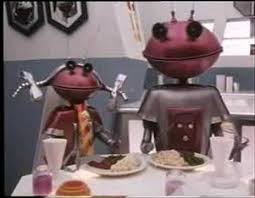 |
| Science fiction wrong: Robots still can't serve up the dinner |
Through the vast netscape of interweb land there are blogs, chatrooms, forums, instructional websites, university sites, commercial sites and more all of which allow you access to a world of food growing knowledge.
(OK.... now if I sound way too impressed by all this, it's because when I started working I had a typewriter to write on and a phone with a dial that required the butt end of a pencil to make a phone call and a few seconds of patience after number to wait for the dial to roll back again.)
Despite the biggest criticism of the internet - it's vast universe of useless info - sometimes the most seemingly useless and flippant information is the best. For example, a post from a guy called Jmaxx taught me why my chillies weren't cropping indoors. The office worker somewhere in the USA accidentally grew a chilli plant by dumping his lunch into a nearby pot plant and then worked out how to pollinate it using a paper clip. He caused me remember the obvious - that there were no bees, or "bugs" as he called them, to pollinate the flowers. At the other end of the scale are the up to date research presentations from departments of universities worldwide - theses, studies and research findings for all so read and benefit from. In the middle is all the rest.
My own personal favourite internet realm is Youtube, the video and clip share website founded less than a decade ago by three former Paypal employees who then made $1.65bn when they sold it to Google after just three years.
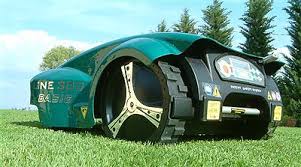 |
| Science fiction right: Lawnbott |
Youtube is unmatched for teaching you some of the trickier gardening tasks - as demonstrated on screen by someone else in the know. Often these people are experts in their fields, sometimes they are not...but often that just adds to the fun. Youtube means access to private tutorials from a worldwide staffroom of tutors and professors of the university of horticulture and food growing life generally. And if you miss a bit of the demo/tutorial, you just play it right back again.
Whilst trying to find out how to prune apple trees, I realised that all my reading up and studying diagrams still didn't make me feel confident enough to give it a go. However, on searching “apples” and “pruning” on YouTube, I located a step by step film made by Fruit Wise Heritage Apples in the UK who keep an orchard with 800 different trees. One of its growers, Stephen Hayes took me step by step through the process, explaining everything in minute detail. It was as if he, the apple grower of fifteen years experience, had given me my own personal tutorial, showing me exactly what to do. And it is this, the “showing” of how it’s done, where YouTube is unmatched.
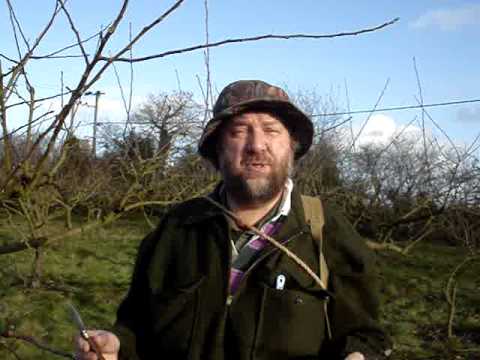 |
| Stephen Hayes, the apple tree sage of Youtube |
Sometimes the experts can be household television names because often entire programmes from mainstream tv are commonly posted on Youtube.
When I wanted to learn about the great urban agricultural revolution which has taken place in Havana, Cuba, I was delighted to find Monty Don to show me around that elegant city and relate how it recovered from near starvation after the Soviet departure, to feeding 90% of the city’s population soley with food grown in small urban allotments, public spaces, even paint tins on balconies.
Who better than the Don and his infectious enthusiasm, to escort us through the city’s organiponicos, the raised bed urban allotments which now feed well over a million people in a miracle which will surely impact on the rest of the world as we approach peak oil.
 |
| Monty Don takes us around the world of food growing on Youtube |
Youtube still bears much of that rag tag spontaneity which made surfing the internet so much fun to surf in its earlier years - before the corporations got stuck in to channel surfers away from those home produced web sites which made the net so much fun in the first place.
Some years ago I met John Evans, holder of no less that eight Guinness World records for giant veg - after I happened across his amazing clips on Youtube. I found his location on the net, I phoned him and was delighted to be invited down to see his garden in West Cork. He had moved back to Ireland after spending most of his life in Alaska. John's eye opening clips include a tour of his former giant vegetable garden in Alaska. Watch him wander in and out amongst the 35 lb cabbages and 45 lb celeries. The garden's not there any more but you can still tour it on Youtube. Take a look, you'll be gobsmacked at what's possible.
John’s secret is his own brand of compost tea, called Bountea which he sells online. He told me how to make my own using compost, soil, an acquarium aerator and molasses. Aerating the diluted mixture multiplies the “good” bacteria in the compost a thousandfold. I used Youtube to research it further. Thanks to Patti Moreno, the Garden Girl and her chat with the “organic mechanic” who showed me how to put it all together using vermicompost as the key ingredient. Find this clip by searching “worm poop tea.”
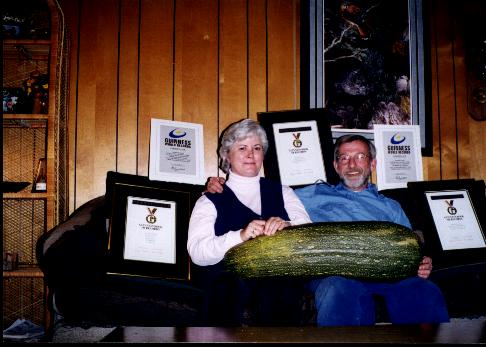 |
| John Evans, his wife and a giant courgette |
Also note her cat drinking out of the bubbling bucket in the background as she delivers to camera.
And here too is added enjoyment withYoutube. Thanks to its endless troops of amateur experts eager to share their knowledge and often using nothing more than a mobile phone camera to record a clip for posting, there are some truly unexpected hilarious moments to be found.
Cassandra, a rather portly mom from Arizona explains how to grow potatoes in a bin to a wobbly camera operated, it emerges, by her bored young son. As Cassandra earnestly details how to line the bin and how to arrange the potatoes, she is unaware that her pressganged cameraman is sticking his fingers in the lens to make it appear that a giant hand is prodding his mother in the behind from on high as he she busies herself chattering and lining the bin.
- “....With such high humidity here in Arizona, I’m always concerned about my dirt drying out in the potato bin...hey, are you paying attention?”
- “Yes mom.”
Also delightful are the clips posted by Frank Cook, an American crusty/hippie with dreadlocks and a wooly cap who was attached to the eatweeds.co.uk website. Frank had his cockney camera crew cracking up as he attempted, in his deadpan mother-earthspeak style, to persuade people to eat dock leaves and other weeds commonly found in urban location. In another clip, he wows us with the qualities of wild blackcurrants and there is a truly classic moment when he turns to the camera and tells us that the blackcurrant plants are “giving us a signal to” (here he punctuates the air by flashing two peace signs, one with each hand) “pay attention.”
 |
| The late great Frank Cook - still imparting his good vibes on Youtube |
Cook has taught me plenty of really useful things, not least that blackcurrants will do quite well in the shade. Thanks to Frank I've made a particularly dark corner of my garden productive for something other than slug attracting hostas and dark green ivy.
Sadly Cook passed away in 2009 although I only found out today.
I have to confess to having felt the sort of twinge of sadness that accompanies the passing of someone you've actually met. This says something not only about Frank's obvious charisma but also the intimate nature of Youtube through which you sometimes feel you almost know those tutors you encounter there. Another great quality of Youtube and the internet overall is it's ability to store that sort of personality and knowledge for years to come. Frank may have passed on years ago but today in cyberspace he's still alive and teaching.
Then are the show offs and the allotment exhibitionists. You can use Youtube to show off. But when the show offs post their allotments, you can then go poking around in their plots with a screen and keyboards (remember when I started work I had a typewriter). The truly great allotments instil envy while those who show off their failings reassure us that we GIYers are not perfect and we all have the same problems.
After taking a virtual tour of George’s allotment in Liverpool (open Youtube and search “raised bed allotment summer 2008) I felt intense pangs of jealously stab in over his meticulously structured food garden which is only a year older than mine.
 |
| Perfect allotments on Youtube make me jealous |
Liverpool George (who you never see as he’s carrying the camera) does demonstrate, as you accompany him by camera around his patch, just how many varieties of food plants you can grow, as well as the sheer amount of it - in a relatively small space. The tour does however lead you to wonder if George is something of a compulsive carpenter – most of his plants grow in expertly put together raised beds, compartments, wood framed cages and timbered mini greenhouses.
Amateurs like Cassandra and George who have no axe to grind or nothing to sell us will become even more important to us knowledge seekers in the years ahead as the better known names in gardening exercise copyright and remove their contributions and clips from Youtube just as so many music stars and tv stations are now starting to do with copyrighted work.
 |
| "Just keep talking like you were just there..." no fogies, no fuss just a phone |
Perhaps the real wonder is that any one of us can become tutors at the university of Youtube or other clip sites - all we need is a mobile phone with a video record and a computer on which to download our wisdom.
And who knows, when I finally get around to using the video option on my new camera, or linking my phone up to the computer, I might even stick Plot 34 up there ...if my nine year old self appointed Head of Secret Tunnels promises to keep his fingers out of the lens that is....


